MalwareDNA —
genetic-level malware analysis in seconds
MalwareDNA is a malware analysis solution developed by Fitsec, which identifies structural similarities in code through genetic analysis and separates targeted attacks from bulk malware in seconds.
You will quickly find out whether you are dealing with:
- a targeted attack,
- bulk malware
- or a safe file
MalwareDNA in a nutshell
- Performs genetic-level malware analysis in seconds
- Based on structural similarity of code, not just hashes or signatures
- Helps separate targeted attacks from bulk malware
- A Finnish solution for demanding environments
Traditional detection is not enough for analysing advanced threats
Traditional classification tells what was found in the file — not which campaign, actor or threat context the observation relates to
MalwareDNA brings structural context to analysis and helps answer questions that traditional detection alone cannot
- Is a single file part of a wider attack?
- Does the observation relate to a previous campaign or malware family?
- How extensively should the environment be investigated and prioritised?
Why is traditional detection not enough against advanced threats?
Traditional tools such as antivirus, hash-based checks, and generic classifications often tell what was found — but not which threat context the finding belongs to

MalwareDNA brings structural context into the analysis and automatically distinguishes whether it is bulk malware or a targeted attack, even if the code has been modified
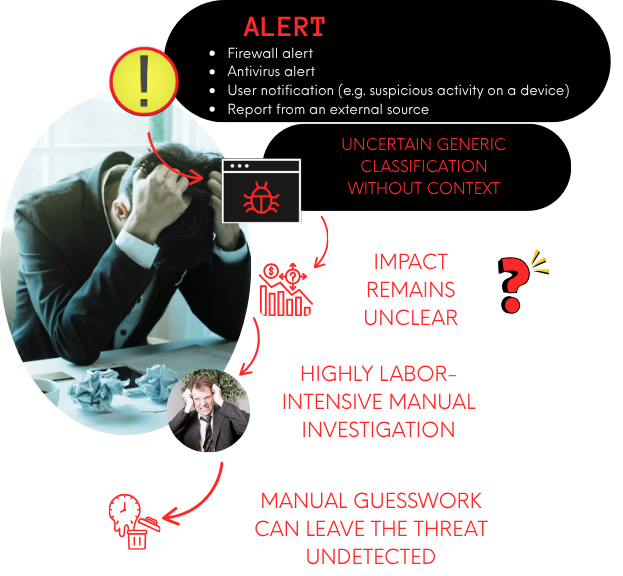
MalwareDNA automates analysis and brings structural context in seconds
How MalwareDNA reduces manual analysis and speeds up response
MalwareDNA accurately identifies PE-format binary files in Windows environments
 .exe
.exe- .dll
- .sys
It does not support other file types, such as Office documents, PDFs, scripts, or web links
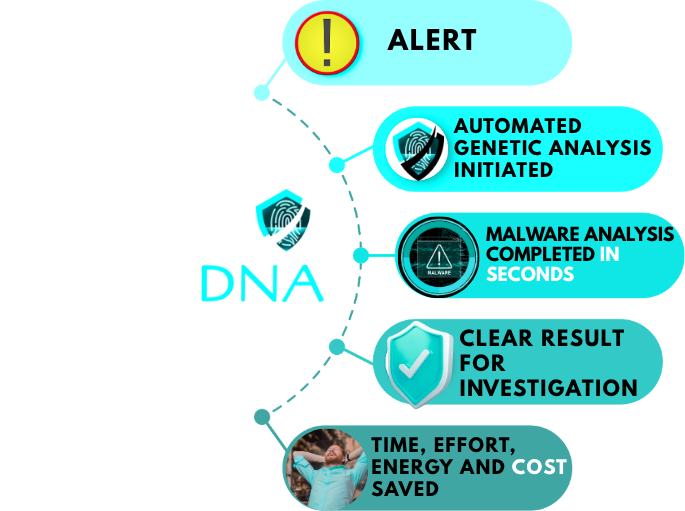
How does gene-level malware analysis work?
MalwareDNA analyzes a suspicious file by breaking it down into a genetic code structure and comparing it against a large malware gene database. The analysis is based on the code’s structural similarity, not just identifiers, hash values, or file type. Results are generated automatically in seconds.
is analyzed
profile
is created
to malware
families
and response
As a result of the analysis, MalwareDNA tells you:
- Whether the file is malicious
- Which malware family it belongs to
- Whether the code contains links to previous attack campaigns
- Whether it is a targeted attack or bulk malware
What sets MalwareDNA apart from traditional cybersecurity tools?
Traditional solutions rely on signatures and file hashes, which means new and modified malware can go undetected. This is especially relevant for teams comparing MalwareDNA to tools such as KTAE or Drakvuf in malware attribution and downstream analysis.
| Traditional tools | MalwareDNA |
|---|---|
| Rely on file hashes and signatures | Based on genetic malware analysis and structural code similarity |
| Often provide a generic classification without context | Also identifies new and modified malware, even if the signature changes |
| Do not show whether the finding is related to a broader campaign | Produces structural links to earlier malware families and campaigns |
| Often require manual follow-up analysis | Delivers analysis results automatically in seconds |
What benefits does MalwareDNA bring to the organisation?
Faster response
You quickly find out whether the case is a targeted attack, bulk malware or a low-risk finding — and how to respond
Less manual analysis work
When classification and structural comparison are automated, experts can focus on investigation, prioritisation and decision-making
Earlier detection
Targeted attacks are identified earlier, before they spread or hide behind generic classification
Better prioritisation
Security team resources are directed to cases requiring immediate investigation, escalation or response
Clearer attack picture
Individual findings combine into a wider threat picture, so the same case does not appear only as isolated alerts
More reliable decision-making
Decisions are based on analysed context, not generic classification or guesswork
Automated malware analysis in seconds
Automated malware analysis in seconds
Manual analysis can take hours. MalwareDNA produces a structural-similarity-based result in seconds
Less manual work
Suspicious files are classified automatically, allowing experts to focus on investigation, prioritisation and response
Faster incident response
Attack relationships are identified faster, easing prioritisation and reducing operational load
Frequently asked questions
What is MalwareDNA and how does it work?
MalwareDNA is an analysis tool that identifies structural and functional similarities between malware samples and groups them efficiently.
How does MalwareDNA differ from traditional malware detection solutions?
Traditional solutions rely on previously known malware or signatures. MalwareDNA examines deeper technical similarities, enabling detection of new and modified variants.
Who is MalwareDNA designed for?
It is designed for large enterprises, SOC teams, threat intelligence units and cyber security research organisations.
Can MalwareDNA detect new or previously unknown malware versions?
Yes. Because the analysis is not based solely on known threats, MalwareDNA can identify new and modified variants based on structural similarity.
How does MalwareDNA analyse malware lineage and evolution?
It compares characteristics and forms relationships between samples, revealing families, evolutionary lines and possible links to threat actors.
What kinds of files and samples can MalwareDNA analyse?
MalwareDNA processes various binary files and malware samples, especially suited to large sample collections.
How does MalwareDNA support threat intelligence work?
It helps identify connections between threats and provides deeper context, accelerating understanding and prioritisation.
Can MalwareDNA help with attribution or identifying threat actor groups?
Yes, indirectly. It surfaces technical similarities that analysts can use to link malware to specific campaigns or actors.
How does MalwareDNA assist malware investigation and analysis?
It automates comparison and grouping, reducing manual work. Analysts can focus on interpretation instead of routine tasks.
Can MalwareDNA integrate with other SOC or analysis tools?
Yes — it is designed to integrate into wider analysis and SOC environments.
Is MalwareDNA suitable for analysing large malware datasets?
Yes. It is built to process large sample volumes and find the relevant connections efficiently.
How does MalwareDNA help identify malware families and variants?
It groups samples by technical similarity, making family and variant identification systematic and transparent.
Can MalwareDNA be used as part of incident response?
Yes. It helps understand malware background and possible links to other cases.
How does MalwareDNA reduce the need for manual malware analysis?
It automates time-consuming comparison and classification, speeding up the analysis process.
Can MalwareDNA be deployed in the organisation's own environment?
Yes. It can be deployed on-premises as needed, enabling secure handling of sensitive data.
What makes MalwareDNA different from other malware analysis solutions?
Its strength is the ability to identify deep technical similarities between malware, providing visibility traditional tools do not offer.
Financial benefits of MalwareDNA
Prevented ICS/SCADA attack
Damage without MalwareDNA:~ €1,000,000
- 2-day production stop: €50,000 / day → €100,000
- Supply chain disruption (delays, contractual penalties): €200,000
- Recovery, forensics, IR services: €150,000
- System rebuild and testing: €250,000
- Regulatory sanctions (e.g. energy sector): €100,000
- Reputation & media attention: €200,000
MalwareDNA helps stop the attack already in the campaign phase, before it reaches ICS systems.
10,000 file analysis becomes more efficient
Saves up to€1,500,000
If manual analysis took 3 h / file at €50/h → 10,000 × 3 h × €50/h = €1,500,000 per year.
MalwareDNA performs the analysis automatically in seconds → all this working time is saved.
Need for one full-time expert reduced
Saves up to€120,000
Manual malware analysis requires deep expertise; one expert costs €60,000–80,000/year. In a large enterprise, two people may be tied up with this work.
MalwareDNA's automated analysis removes the need to hire or frees existing experts for other tasks.